Vitamin D2 Versus Vitamin D3: What Is the Difference?

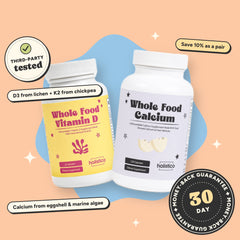
Vitamin D2 versus vitamin D3 comes down to who makes it. D2, called ergocalciferol, forms in fungi and yeast when UV light hits them. D3, called cholecalciferol, is the form your own skin makes from sunlight. It is found in animal foods, and lichen makes it too. Holistico Whole Food Vitamin D uses D3 from lichen.
What Is the Difference Between Vitamin D2 and D3?
On paper, a small one. The NIH vitamin D fact sheet puts it this way: "In foods and dietary supplements, vitamin D has two main forms, D2 (ergocalciferol) and D3 (cholecalciferol), that differ chemically only in their side-chain structures. Both forms are well absorbed in the small intestine."
A side chain is the tail of the molecule. The two forms also differ in where they come from, which foods carry them, and how far each moves the vitamin D level in your blood.
| Vitamin D2 | Vitamin D3 | |
|---|---|---|
| Chemical name | Ergocalciferol | Cholecalciferol |
| Made in nature by | Fungi and yeast, from ergosterol under UV light | Human and animal skin, from 7-dehydrocholesterol under UVB light; also lichen |
| Found in food | Mushrooms exposed to UV light; some fortified milk substitutes | Animal foods, such as fish liver oils |
| Made for supplements from | Ergosterol taken from yeast, then put under UV light | Lanolin from sheep's wool, or lichen |
Where Does Vitamin D2 Come From?
Fungi. Mushrooms and yeast hold a compound called ergosterol in their cell walls, and UV light turns it into vitamin D2. A 2018 review of mushrooms as a source of vitamin D describes the step: "When exposed to UV radiation, ergosterol in the mushroom cell wall is transformed to pre-vitamin D2." The same review notes that "The most common form of vitamin D in mushrooms is D2."
That is why mushroom packs sometimes say "UV-exposed" or "high in vitamin D". Growers shine light on them after harvest to raise the D2.
For supplements and fortified foods, D2 is made the same way at scale. The FDA's food rule for vitamin D says D2 is "produced by ultraviolet irradiation of ergosterol isolated from yeast and related fungi." The National Academies report on vitamin D adds that "some milk substitutes are fortified with vitamin D2."
Where Does Vitamin D3 Come From?
Mostly from you. The National Academies report says D3 "is synthesized in human skin from 7-dehydrocholesterol following exposure to ultraviolet B" light. It also reaches you through animal foods. The FDA rule says D3 "occurs in, and is isolated from, fish liver oils."
Your skin cannot always keep up. The NIH lists "the season, time of day, length of day, cloud cover, melanin content of the skin, and other factors" as things that change how much vitamin D sunlight gives you.
Lichen is the other natural maker. A lichen is a fungus living with a partner that makes food from light. A 2018 review of vitamin D in nature describes lichens forming D3 when UV light reaches the sterols in their cell membranes. A Swedish team measured 0.67 to 2.04 micrograms of D3 per gram of one dried wild lichen, and found more D3 in lichen from sunnier places.
How Are D2 and D3 Made for Supplements?
Most D2 starts with yeast, as the FDA rule describes. Much of the D3 on the shelf starts with lanolin, the grease washed out of sheep's wool. A compound from that grease goes under UV lamps too, which is the factory version of what happens in skin. We wrote about that process in vitamin D from lichen vs lanolin.
Lichen D3 takes a shorter road. The lichen grows in the wild, sunlight makes the D3 inside it, and the vitamin is then extracted. It is the same cholecalciferol molecule, made the way your skin makes it, with no animal involved in that step.
How Do D2 and D3 Compare in Research?
Both forms work in the body. The National Academies report says that "most of the steps involved in the metabolism and actions of vitamin D2 and vitamin D3 are identical." Both are turned by the liver into the form that a vitamin D blood test measures.
The difference shows up in how far each one moves that blood level. The NIH fact sheet says both forms can raise it, and reports that D3 raises it further and holds it higher for longer than D2. The National Academies put the comparison plainly: "it would appear that at low doses, D2 and D3 are equivalent, but at high doses, D2 is less effective than D3."
So D2 does its job, and D3 is the form the body makes for itself. That second fact is the one we built our formula on.
Why Did Holistico Choose D3 From Lichen?
We chose cholecalciferol because it is the vitamin D your skin makes in summer. We chose lichen because it makes that D3 from sunlight, the same way your skin does, and skips the wool grease. You can read more about the molecule itself in what is cholecalciferol.
Then we did what a whole food formula does. We start with one nutrient from a natural source and add the foods that carry its partners. Each capsule of Holistico Whole Food Vitamin D holds:
- 125 mcg (5,000 IU) of vitamin D3 from wild-harvested lichen.
- 50 mcg of vitamin K2 as MK-7, from fermented non-GMO chickpeas. We never sell D3 without K2, because vitamin D helps your body absorb calcium and vitamin K2 supports normal calcium metabolism in the body.*
- 150 mg of beef liver powder, a food naturally rich in vitamin A.
- 50 mg of red marine algae, harvested from the seabed off the west coast of Ireland and the northwest coast of Iceland, carrying magnesium and more than 70 trace minerals.
- 69.5 mg of coconut oil powder, because vitamin D is fat-soluble.
There is no magnesium stearate, silicon dioxide, titanium dioxide, gums or carrageenan. Each current lot passed independent heavy metal and microbe testing, and the full reports are on our lab results page. If you wonder why the capsule holds 5,000 IU, our page on the amount explains it. See the full label for Whole Food Vitamin D.
Questions People Ask About Vitamin D2 and D3
Is ergocalciferol the same as cholecalciferol?
No. Ergocalciferol is vitamin D2 and cholecalciferol is vitamin D3. The NIH says the two differ chemically only in their side chains, and both are well absorbed. D2 comes from fungi and yeast. D3 is the form your skin makes from sunlight, and the form in Holistico Whole Food Vitamin D, where it comes from lichen. A supplement label names the form in brackets after "Vitamin D": ours reads "(as Cholecalciferol) (from Lichen)".
What foods have vitamin D2?
Mushrooms are the main one. A 2018 review found D2 is the most common form of vitamin D in mushrooms, and mushrooms put under UV light after harvest carry much more of it. Yeast holds the raw material, ergosterol. The National Academies also note that some milk substitutes are fortified with D2. Animal foods, such as fish liver oils, carry D3 instead.
Is vitamin D3 or D2 better?
Both forms work, and most steps in how the body uses them are the same. The difference is in blood levels: the NIH reports that D3 raises them further and keeps them higher for longer than D2. That is one reason we chose D3 for Holistico Whole Food Vitamin D. A blood test before and after shows you what any form is doing for you, which is why our rule is test, don't guess.
Is vitamin D2 vegan?
Yes, D2 itself is vegan, because it comes from yeast and fungi. Check the whole product, though, since a capsule shell or other ingredients can come from animals. D3 can be vegan too when it comes from lichen. Our lichen D3 involves no animal at the source, but Holistico Whole Food Vitamin D also contains beef liver, so the capsule is not vegan or vegetarian.
Is lichen vitamin D3 vegan?
The D3 is. Lichen is a fungus living with a partner that makes food from light, so no animal is part of making the vitamin. A finished supplement can still contain animal ingredients. Ours adds beef liver on purpose, a food naturally rich in vitamin A, so the product is not vegan.
Should I take vitamin D2 supplements or D3?
That depends on your diet and on where your levels stand, and your practitioner can help you weigh it. Our choice for Holistico was D3, the form your skin makes, from lichen, with K2 and partner foods in the same capsule. If you are unsure whether you need vitamin D at all, start with a test. The nutrient test we offer includes vitamin D among its markers.
Why does Holistico pair D3 with K2?
Because the two work on the same mineral. Vitamin D helps your body absorb calcium, and vitamin K2 supports normal calcium metabolism in the body.* Katie calls K2 vitamin D's best friend. So every capsule of Holistico Whole Food Vitamin D has 50 mcg of K2 as MK-7, fermented from chickpeas, next to the lichen D3.
Does vitamin D need fat to absorb?
Fat helps. The NIH says "The concurrent presence of fat in the gut enhances vitamin D absorption, but some vitamin D is absorbed even without dietary fat." That applies to D2 and D3 alike. We add coconut oil powder to our capsule for that reason, and we suggest taking it with a meal. Katie takes hers every morning at breakfast.
Important Safety Notes
- This article is general education. It is not medical advice and does not replace a conversation with your own practitioner.
- If you are pregnant, nursing or taking any medication, talk to your healthcare practitioner before you start a supplement.
- Holistico Whole Food Vitamin D contains beef liver powder and coconut (a tree nut allergen). It is not vegan or vegetarian.
- *These statements have not been evaluated by the Food and Drug Administration. This product is not intended to diagnose, treat, cure, or prevent any disease.
The Bottom Line
Vitamin D2 is ergocalciferol, made by fungi and yeast under UV light and found in UV-exposed mushrooms. Vitamin D3 is cholecalciferol, the form your skin makes from sunlight, found in animal foods and also made by lichen. Both work in the body, and the NIH reports that D3 raises blood levels further and holds them longer. We chose D3 from lichen for Holistico Whole Food Vitamin D and paired it with whole food partners: K2 from chickpeas, beef liver, red algae and coconut oil.
References
- National Institutes of Health, Office of Dietary Supplements (2025). Vitamin D: Fact Sheet for Health Professionals. Bethesda, MD: NIH.
- Institute of Medicine (2011). Overview of Vitamin D. In: Dietary Reference Intakes for Calcium and Vitamin D, chapter 3. Washington, DC: The National Academies Press.
- U.S. Food and Drug Administration. 21 CFR 184.1950, Vitamin D. Code of Federal Regulations, Title 21.
- Cardwell, G., Bornman, J. F., James, A. P., & Black, L. J. (2018). A review of mushrooms as a potential source of dietary vitamin D. Nutrients, 10(10), 1498.
- Göring, H. (2018). Vitamin D in nature: a product of synthesis and/or degradation of cell membrane components. Biochemistry (Moscow), 83(11), 1350-1357.
- Spribille, T., Tuovinen, V., Resl, P., et al. (2016). Basidiomycete yeasts in the cortex of ascomycete macrolichens. Science, 353(6298), 488-492.
- Wang, T., Bengtsson, G., Kärnefelt, I., & Björn, L. O. (2001). Provitamins and vitamins D2 and D3 in Cladina spp. over a latitudinal gradient: possible correlation with UV levels. Journal of Photochemistry and Photobiology B, 62(1-2), 118-122.