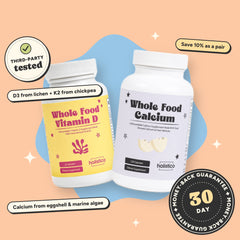
Vitamin D From Lichen vs Lanolin: Why We Chose Lichen

Lichen vitamin D and lanolin vitamin D are both vitamin D3. What differs is how each one comes to exist. Lichen makes D3 from sunlight, the same way your skin does. Lanolin D3 starts as grease washed out of sheep's wool and becomes a vitamin in a factory. We chose lichen for Holistico Whole Food Vitamin D, and this is why.
Vitamin D From Lichen vs Lanolin: What Is the Difference?
Both give you cholecalciferol, the vitamin D3 your own skin makes. The FDA's food rule for vitamin D lists it as one compound. The starting material, the steps in between and the animal question are where the two part ways.
| Lanolin D3 | Lichen D3 | Vitamin D2 | |
|---|---|---|---|
| Starts from | Grease washed from sheep's wool | Lichen, a living organism | Yeast and other fungi |
| How the vitamin forms | A compound taken from the grease is put under UV lamps, heated and purified | Sunlight on the growing lichen makes it, and it is then extracted | A fungal compound is put under UV lamps and purified |
| Animal involved | Yes | No | No |
| Name on the label | Cholecalciferol | Cholecalciferol (from lichen) | Ergocalciferol |
How Is Vitamin D3 Made From Lanolin?
Most D3 in supplements comes from lanolin, the grease in sheep's wool, according to a British Nutrition Foundation review.
Getting from wool to vitamin takes several steps. A 2024 review of vitamin D production sets them out. A compound called 7-dehydrocholesterol is extracted from the lanolin. It is exposed to ultraviolet light. Heat rearranges the result into D3, and chromatography purifies it.
The chemistry copies what skin does in sunlight. It happens in a factory, and it starts with wool grease.
How Does Lichen Make Vitamin D3?
A lichen is two living things in one. Biologists describe it as a fungus living with a partner that makes food from light, usually an algae. It grows out in the open, on rock, bark and soil.
Sunlight does the rest. A 2018 review explains that ultraviolet light turns compounds in the lichen's cell membranes into vitamin D. Your skin works the same way: UVB light opens up 7-dehydrocholesterol, and warmth finishes the job. When a Swedish team measured vitamin D3 in wild lichen, they found more of it in lichen from sunnier sites.
So the D3 is already in the lichen when it is gathered. It is extracted and concentrated, and nobody has to make it under lamps.
Why Did We Choose Lichen?
We had four reasons.
- It is D3, the form your skin makes. Plant vitamin D is usually D2, which is a different compound.
- A living organism made it from sunlight, the way your body does.
- Ours is wild-harvested. No sheep's wool is involved, and no factory step turns grease into a vitamin.
- It belongs with the rest of the capsule. We make whole food supplements, so our vitamin D had to come from something that grew.
If you read the ingredients on your food, it makes sense to read them on your vitamin D too. That is why we make whole food supplements.
What Sits Beside the Lichen D3 in Our Capsule?
In food, vitamin D arrives with partners. Holistico Whole Food Vitamin D puts them back around the lichen D3.
Each capsule has 125 mcg (5,000 IU) of D3 from lichen and 50 mcg of vitamin K2 fermented from non-GMO chickpeas. I call K2 the traffic controller for D3. Vitamin D brings calcium in, and K2 switches on the bone protein that holds on to it. We never sell D3 without it.
Around those two we add 150 mg of beef liver powder for its naturally occurring retinol, 50 mg of red marine algae for its magnesium and trace minerals, and 69.5 mg of coconut oil powder, because vitamin D is absorbed with fat.
The beef liver means the capsule is not vegetarian, and the coconut is a tree nut. We made that choice on purpose. Liver is one of the common food sources of preformed vitamin A, and we wanted the real food in there.
You will find no magnesium stearate, silicon dioxide, titanium dioxide, gums or carrageenan in the capsule. Every batch is tested for potency and identity, then third-party tested for heavy metals and microbial safety. We suggest one capsule a day with food, and our rule on amounts is test, don't guess: check your levels and go through the results with your practitioner.
Is Your Vitamin D From Lanolin or Lichen?
The label can tell you. Look at the words in brackets after "Vitamin D" in the Supplement Facts panel. FDA's labeling guide says a maker may list the source of an ingredient there.
- "Cholecalciferol" means D3, and "ergocalciferol" means D2.
- "From lichen" names the source. Our panel reads "Vitamin D (as Cholecalciferol) (from Lichen)".
- "Lanolin" or "from sheep's wool" names the usual source.
- "Cholecalciferol" with nothing after it leaves the question open, so ask the maker.
Whole food supplements name their food sources. A panel that lists only chemical names is telling you something as well.
Questions People Ask About Lichen Vitamin D
What is lichen in vitamin D?
Lichen is the source. A lichen is a fungus living with a partner, usually an algae, that makes food from light, and sunlight turns compounds in it into vitamin D3. When a label says "from lichen", the D3 was extracted from lichen and no sheep's wool was involved. Holistico Whole Food Vitamin D uses wild-harvested lichen.
Is lichen a good source of vitamin D3?
Yes, once it is concentrated. A Swedish study measured 0.67 to 2.04 micrograms of D3 in each gram of one dried wild lichen, with more in lichen from sunnier sites. At the top of that range, the D3 in one 125 mcg capsule is what about 61 grams of that lichen holds. That is why lichen D3 is gathered and concentrated for supplements.
Is lichen vitamin D3 good?
Yes. It is cholecalciferol, the same vitamin D3 your skin makes in sunlight, and it comes from an organism that makes it the same way. No animal product goes into the D3 itself. We chose it for Holistico Whole Food Vitamin D and paired it with K2, beef liver, red algae and coconut oil.
Is vitamin D from lichen the same as cholecalciferol?
Yes. Cholecalciferol is the chemical name for vitamin D3, whatever it comes from. The Swedish team confirmed that the vitamin in their lichen was D3. Our own panel prints the two together, as "Vitamin D (as Cholecalciferol) (from Lichen)", so you can see both the form and the source.
Is vitamin D3 better than vitamin D2?
At raising the blood level, D3 has the edge. A 2024 analysis of daily-dose trials found the rise in blood vitamin D was about 40% smaller with D2 than with D3. D3 is also the form your skin makes. Lichen is how you get D3 without lanolin, which is one reason we use it.
What is the healthiest vitamin D3 to take?
We think it is the one that looks most like food. That means D3 from a named natural source, the partners vitamin D has in food, a short "other ingredients" line and lab results you can ask for. Holistico Whole Food Vitamin D was made to that list: lichen D3, K2 from fermented chickpeas, beef liver, red algae and coconut oil.
What helps vitamin D absorption?
Fat, first of all. The National Academies report says vitamin D is absorbed most efficiently with foods that contain fat, and in one study of 50 healthy older adults, peak D3 in the blood was 32% higher after a meal with fat. That is why our capsule carries coconut oil, and why we suggest taking it with food.
What is the best vitamin D3 for vegans?
Lichen D3 is the one to look for, because no animal product goes into it. The British Nutrition Foundation review says D3 from lichen suits vegans. Then read the whole label. We pair our lichen D3 with beef liver for its retinol, so Holistico Whole Food Vitamin D is not a vegan vitamin D3 K2 supplement, and we chose the liver on purpose.
What is the purest D3 K2 supplement?
Pure should mean you can account for everything in the capsule. Check the source of each vitamin, the "other ingredients" line and the lab testing. Holistico Whole Food Vitamin D names every source, has rice flour and bamboo extract as its only other ingredients besides the capsule shell, and is third-party tested for heavy metals and microbial safety.
Important Safety Notes
- This article is general education. It is not medical advice, and it does not replace a conversation with your own practitioner.
- If you are pregnant, nursing or taking any medication, talk to your healthcare practitioner before you start.
- Vitamin K is involved in normal blood clotting. Anyone on a blood-thinning medicine needs their prescriber's go-ahead before adding it.
- Holistico Whole Food Vitamin D contains beef liver powder and coconut (a tree nut allergen).
- These statements have not been evaluated by the Food and Drug Administration. This product is not intended to diagnose, treat, cure, or prevent any disease.
The Bottom Line
Lichen vitamin D is D3, the form your skin makes. Lanolin D3 is the same vitamin built in a factory from sheep's wool grease, while lichen makes its D3 from sunlight and is simply gathered and concentrated. We chose lichen because we want every nutrient to come from something that grew. Then we put its food partners beside it: K2, beef liver, red algae and coconut oil. That capsule is Holistico Whole Food Vitamin D.
Next, read why vitamin D3 and K2 belong in one capsule, or what happens when you take vitamin D3 and K2 every day.
References
- U.S. Food and Drug Administration. Vitamin D. Code of Federal Regulations, Title 21, Section 184.1950.
- Spiro, A., & Buttriss, J. L. (2014). Vitamin D: an overview of vitamin D status and intake in Europe. Nutrition Bulletin, 39(4), 322-350.
- García-Domínguez, M., Gutiérrez-del-Río, I., Villar, C. J., Perez-Gomez, A., Sancho-Martinez, I., & Lombó, F. (2024). Structural diversification of vitamin D using microbial biotransformations. Applied Microbiology and Biotechnology, 108(1), 409.
- Spribille, T., Tuovinen, V., Resl, P., Vanderpool, D., Wolinski, H., Aime, M. C., et al. (2016). Basidiomycete yeasts in the cortex of ascomycete macrolichens. Science, 353(6298), 488-492.
- Göring, H. (2018). Vitamin D in nature: a product of synthesis and/or degradation of cell membrane components. Biochemistry (Moscow), 83(11), 1350-1357.
- Jäpelt, R. B., & Jakobsen, J. (2013). Vitamin D in plants: a review of occurrence, analysis, and biosynthesis. Frontiers in Plant Science, 4, 136.
- Wang, T., Bengtsson, G., Kärnefelt, I., & Björn, L. O. (2001). Provitamins and vitamins D2 and D3 in Cladina spp. over a latitudinal gradient: possible correlation with UV levels. Journal of Photochemistry and Photobiology B: Biology, 62(1-2), 118-122.
- Institute of Medicine (2001). Vitamin K. In: Dietary Reference Intakes for Vitamin A, Vitamin K, Arsenic, Boron, Chromium, Copper, Iodine, Iron, Manganese, Molybdenum, Nickel, Silicon, Vanadium, and Zinc, chapter 5. Washington, DC: The National Academies Press.
- U.S. Food and Drug Administration (2005). Dietary Supplement Labeling Guide: Chapter IV. Nutrition Labeling.
- van den Heuvel, E. G., Lips, P., Schoonmade, L. J., Lanham-New, S. A., & van Schoor, N. M. (2024). Comparison of the effect of daily vitamin D2 and vitamin D3 supplementation on serum 25-hydroxyvitamin D concentration (total 25(OH)D, 25(OH)D2, and 25(OH)D3) and importance of body mass index: a systematic review and meta-analysis. Advances in Nutrition, 15(1), 100133.
- Institute of Medicine (2011). Overview of Vitamin D. In: Dietary Reference Intakes for Calcium and Vitamin D, chapter 3. Washington, DC: The National Academies Press.
- Dawson-Hughes, B., Harris, S. S., Lichtenstein, A. H., Dolnikowski, G., Palermo, N. J., & Rasmussen, H. (2015). Dietary fat increases vitamin D-3 absorption. Journal of the Academy of Nutrition and Dietetics, 115(2), 225-230.