Vitamin D3 With K2 Benefits: Why These Two Belong in One Capsule

The benefits of vitamin D3 with K2 come down to calcium. Vitamin D3 helps your body absorb it. Vitamin K2 switches on the protein that holds it in bone. They are two steps in one job, which is why we never sell D3 without K2. In food, nutrients like these arrive together, so we built our capsule the same way.
What Are the Benefits of Vitamin D3 With K2?
Start with vitamin D. The National Academies call its role in calcium absorption well established. In Europe, the food safety authority EFSA reviewed the evidence and accepted a cause-and-effect link between vitamin D and normal bones and teeth, the absorption of calcium, and normal calcium levels in the blood.
Vitamin K has accepted jobs of its own. The same panel signed off on its role in normal bones and in normal blood clotting.
So the benefits of a vitamin D3 K2 pairing are calcium absorption, bones, teeth and normal clotting. Regulators on both sides of the Atlantic stand behind that list.
Why Are Vitamin D3 and K2 Paired?
Because they handle the same mineral at different steps.
Vitamin D goes first. It helps your gut take calcium in from food. Vitamin K comes later. Some proteins in the body only switch on after vitamin K has activated them. One is osteocalcin, a protein made in bone that can hold on to bone mineral once it is active.
I call K2 the traffic controller for D3. Vitamin D brings the calcium in. K2 switches on the protein that holds it in bone.
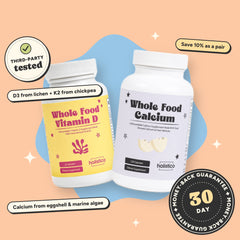
That is the reason every capsule of Holistico Whole Food Vitamin D carries both: 125 mcg (5,000 IU) of D3 and 50 mcg of K2.
What Else Does Vitamin D Need to Do Its Job?
K2 is one partner. Vitamin D has others.
Fat comes first. Vitamin D is fat-soluble, and the National Academies report says it is absorbed most efficiently when it is eaten with foods that contain fat. In one study of 50 healthy older adults, peak vitamin D3 in the blood was 32% higher after a meal with fat than after a fat-free one.
Magnesium is next. Your body has to convert vitamin D before it can use it, and a 2018 review reported that every enzyme doing that work appears to need magnesium.
Then there is vitamin A. In food, vitamin D seldom travels alone. Fish is on the National Academies' short list of natural vitamin D sources, and it is on their list of common sources of preformed vitamin A too, next to liver and dairy.
Food worked this out long before supplements did. A review in the American Journal of Clinical Nutrition put it this way: "Many examples are provided of superior effects of whole foods over their isolated constituents."
Most vitamin K2 and D3 supplements stop at the two vitamins. We kept going, and this is why we make whole food supplements.
What Is in Holistico Whole Food Vitamin D?
One nutrient from a whole food, plus the foods that carry its partners. Here is the full label, with the reason we chose each ingredient.
| Ingredient | Per capsule | Why it is there |
|---|---|---|
| Vitamin D3 from wild-harvested lichen | 125 mcg (5,000 IU) | Lichen makes D3 from sunlight, the same way your skin does |
| Vitamin K2 as MK-7, fermented from non-GMO chickpeas | 50 mcg | The traffic controller for D3 |
| Beef liver powder | 150 mg | A whole food that naturally contains retinol, the form of vitamin A found in animal foods |
| Red marine algae | 50 mg | It builds its skeleton from seawater minerals, with magnesium among them |
| Coconut oil powder | 69.5 mg | A food source of fat, because vitamins D and K are fat-soluble |
| Horseradish tree (moringa) leaf | 145 mg | The whole leaf, dried and milled, for its trace minerals |
| Black pepper fruit | 10 mg | The whole ground fruit |
| Rosemary leaf extract | 0.5 mg | A natural antioxidant that keeps the capsule fresh |
Eight ingredients, each one traceable to the food or organism it came from. The only other things in the capsule are rice flour, bamboo extract and the vegetable capsule shell. You will find no magnesium stearate, silicon dioxide, titanium dioxide, gums or carrageenan. Every batch is tested for potency and identity, then third-party tested for heavy metals and microbial safety.
We suggest one capsule a day with food. The capsule contains beef liver and coconut (a tree nut), so it is not vegetarian. We prioritize bioavailability over plant-based.
See Whole Food Vitamin D, or pair it with our eggshell and algae calcium in the bundle.
Why Does Our Capsule Have 5,000 IU of Vitamin D3?
Because that is about what a body gets through in a day. In a winter study of 67 healthy men in Omaha, researchers gave daily vitamin D3 at several amounts, 125 mcg among them, and estimated that the men were using 3,000 to 5,000 IU a day. Most of it came out of stores laid down by summer sun. When the sun has not filled those stores, food and supplements have to supply more of it.
That was one study, in men, in one city. Your own number depends on your sun, your skin and your plate, so our rule is test, don't guess. The nutrient test we offer reads 55 markers inside your white blood cells, vitamin D, vitamin A, K2, calcium and magnesium among them, and your practitioner can go through the results with you.
How Do You Pick a Vitamin K2 and D3 Supplement?
Turn the bottle around. Four places on the back tell you most of what you need.
- The vitamin D line. Look for the source in brackets, such as "from lichen". Plain "cholecalciferol" tells you the form and leaves the source out.
- The vitamin K line. Vitamin K1 is the leafy-greens form. We use K2 as MK-7, the form found in fermented foods.
- The rest of the panel. Check whether the partners are there (a fat, a vitamin A food, a mineral source) or whether it is two vitamins and a filler.
- The "other ingredients" line and the testing. You want a short list, and a maker who will send you the lab report.
- Look for third-party testing. We send all of our formulas to Alkemist Labs for independent third-party testing.
A multivitamin takes the opposite approach and gives you a little bit of many nutrients in one tablet. We would rather give you one nutrient at the amount printed on the bottle, with the foods that carry its partners. Check your levels first, then consider taking what you are low in.
Questions People Ask About Vitamin D3 With K2
What are vitamins D3 and K2 good for?
Vitamin D3 helps your body absorb calcium, keeps blood calcium at a normal level, and is needed for normal bones and teeth. Vitamin K2 is a form of vitamin K, which the body needs for normal bones and normal blood clotting. The European Food Safety Authority accepted each of those roles when it reviewed the two vitamins.
Do you need K2 if you take vitamin D3?
We think so, and it is why Holistico never sells D3 without it. D3 raises the amount of calcium you absorb. K2 switches on osteocalcin, the bone protein that holds on to that calcium. Food has some K2, with natto far ahead of cheese, eggs and meat. Few of us eat natto every day, so each of our capsules carries 50 mcg fermented from non-GMO chickpeas.
Which brand of D3 and K2 is best?
The best one is the one whose label you can read from top to bottom. Look for D3 with its source named, K2 as MK-7, the partner foods in the same capsule, and lab reports the maker will share. Holistico Whole Food Vitamin D was built to that list: lichen D3, K2 from fermented chickpeas (MK-7), beef liver, red algae and coconut oil, third-party tested.
What are the vitamin D3 + K2 benefits for women?
The roles are the same for everyone: calcium absorption, bones and teeth for vitamin D, and bone proteins and normal clotting for vitamin K. What changes for women is the amount needed at each stage of life. The National Academies set vitamin D intakes by age, pregnancy and nursing. If you are pregnant or nursing, we suggest asking your practitioner before you start any supplement.
What are the vitamin D3 + K2 benefits for men?
The same two jobs. Vitamin D helps you absorb calcium, and vitamin K switches on the proteins that use it. Men need a little more vitamin K: the National Academies set 120 mcg a day for men and 90 for women. And in a winter study of 67 healthy men, the body used an estimated 3,000 to 5,000 IU of vitamin D3 a day, most of it from summer stores.
Should I take D3 and K2 at the same time?
Yes. Both are fat-soluble, both work on calcium, and food often carries them together. Egg yolk has the two of them. One capsule with a meal covers both, which is how we make Holistico Whole Food Vitamin D. We suggest one a day with food.
What is the best time to take vitamin D3 and K2?
With a meal that has some fat in it, at whatever hour you will remember. In one study of 50 healthy older adults, peak vitamin D3 in the blood was 32% higher after a meal with fat than after a fat-free meal. We put coconut oil in the capsule for the same reason, and we still suggest taking it with food.
Which foods are rich in vitamin D3 and K2?
Few. For vitamin D, the National Academies name fatty fish, fish liver oil and egg yolk, with sunlight on skin as the body's other source. For K2, a European Food Safety Authority review lists meat, cheese and eggs, and puts natto, a fermented soybean dish, far ahead. A list that short is the reason we make a whole food capsule.
Can I take vitamin D3 and K2 every day?
Yes. Daily is how we suggest taking ours: one capsule a day with a meal. The National Academies report says the rise in blood vitamin D tends to level off by about week six of a steady daily amount. A blood test before you start and another after that point shows you the change.
Important Safety Notes
- This article is general education. It is not medical advice, and it does not replace a conversation with your own practitioner.
- If you are pregnant, nursing or taking any medication, talk to your healthcare practitioner before you start.
- Vitamin K is involved in normal blood clotting. Anyone on a blood-thinning medicine needs their prescriber's go-ahead before adding it.
- Holistico Whole Food Vitamin D contains beef liver powder and coconut (a tree nut allergen).
- These statements have not been evaluated by the Food and Drug Administration. This product is not intended to diagnose, treat, cure, or prevent any disease.
The Bottom Line
Vitamin D3 with K2 is a pairing built around calcium. D3 helps you absorb it, and K2 switches on the protein that holds it in bone. Vitamin D keeps other company in food too: fat, magnesium, trace minerals and vitamin A. Holistico Whole Food Vitamin D puts them in one capsule, with D3 from lichen, K2 from fermented chickpeas, beef liver, red algae and coconut oil. Test, don't guess, then take one a day with a meal.
Next, read what happens when you take vitamin D3 and K2 every day, or why our D3 comes from lichen and not lanolin.
References
- Institute of Medicine (2011). Overview of Vitamin D. In: Dietary Reference Intakes for Calcium and Vitamin D, chapter 3. Washington, DC: The National Academies Press.
- Institute of Medicine (2001). Vitamin K. In: Dietary Reference Intakes for Vitamin A, Vitamin K, Arsenic, Boron, Chromium, Copper, Iodine, Iron, Manganese, Molybdenum, Nickel, Silicon, Vanadium, and Zinc, chapter 5. Washington, DC: The National Academies Press.
- Institute of Medicine (2001). Vitamin A. In: Dietary Reference Intakes for Vitamin A, Vitamin K, Arsenic, Boron, Chromium, Copper, Iodine, Iron, Manganese, Molybdenum, Nickel, Silicon, Vanadium, and Zinc, chapter 4. Washington, DC: The National Academies Press.
- EFSA Panel on Dietetic Products, Nutrition and Allergies (2009). Scientific Opinion on the substantiation of health claims related to vitamin D and maintenance of bone and teeth, absorption and utilisation of calcium and phosphorus and maintenance of normal blood calcium concentrations, cell division, and thyroid function. EFSA Journal, 7(9), 1227.
- EFSA Panel on Dietetic Products, Nutrition and Allergies (2009). Scientific Opinion on the substantiation of health claims related to vitamin K and maintenance of bone, blood coagulation, and function of the heart and blood vessels. EFSA Journal, 7(9), 1228.
- Dawson-Hughes, B., Harris, S. S., Lichtenstein, A. H., Dolnikowski, G., Palermo, N. J., & Rasmussen, H. (2015). Dietary fat increases vitamin D-3 absorption. Journal of the Academy of Nutrition and Dietetics, 115(2), 225-230.
- Uwitonze, A. M., & Razzaque, M. S. (2018). Role of magnesium in vitamin D activation and function. Journal of the American Osteopathic Association, 118(3), 181-189.
- Jacobs, D. R., Gross, M. D., & Tapsell, L. C. (2009). Food synergy: an operational concept for understanding nutrition. American Journal of Clinical Nutrition, 89(5), 1543S-1548S.
- Heaney, R. P., Davies, K. M., Chen, T. C., Holick, M. F., & Barger-Lux, M. J. (2003). Human serum 25-hydroxycholecalciferol response to extended oral dosing with cholecalciferol. American Journal of Clinical Nutrition, 77(1), 204-210.
- EFSA Panel on Dietetic Products, Nutrition and Allergies (2017). Dietary reference values for vitamin K. EFSA Journal, 15(5), e04780.