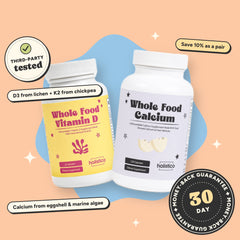
Why our vitamin D3 is 5,000 IU
Katie's reasons, the numbers from the experts who set the limits, and who it is for.
Each capsule of our Whole Food Vitamin D3 + K2 holds 5,000 IU (125 mcg) of vitamin D3 from lichen. Katie McKersie, Holistic Nutrition Consultant, chose that amount from what she sees in her practice: adults who have tested low, or who get little sun, need enough vitamin D to bring their levels up in a reasonable time.
Why Katie chose 5,000 IU
"I chose 5,000 IU because it is the amount I see most adults actually need in my practice, especially through winter or for anyone who gets very little sun. It suits adults who have tested low, or who cannot get regular sun exposure."
Katie McKersie, Holistic Nutrition Consultant and founder of Holistico
"People who have low vitamin D need a 5,000 IU dose to move the needle in a reasonable amount of time. In my practice, lower doses have not done that."
Katie McKersie
Is 5,000 IU a day too much?
5,000 IU sits between two numbers from the same expert report. In 2011 the Food and Nutrition Board set 4,000 IU a day as the upper intake level for adults. It started from 10,000 IU a day, the intake at which it found no adverse effects, and set the limit lower on purpose to leave a safety margin.
In the report's own words:
"An intake value of 10,000 IU/day reflects a NOAEL [no observed adverse effect level]. This NOAEL is initially adjusted for uncertainty to establish a UL of 4,000 IU/day."
Food and Nutrition Board, Dietary Reference Intakes for Calcium and Vitamin D (2011), chapter 6
The same chapter reviews earlier research: "Hathcock et al. (2007), following an analysis of more than 20 publications, concluded that there was no association between harm and intakes of 10,000 IU/day."
So the upper limit has a safety margin built in. It is not a target, and it is not the point where harm begins.
| Micrograms | IU | |
|---|---|---|
| Recommended intake for adults | 15 to 20 mcg | 600 to 800 IU |
| Upper intake level for adults | 100 mcg | 4,000 IU |
| One Holistico capsule (label) | 125 mcg | 5,000 IU |
| No adverse effects found (starting point for the upper limit) | 250 mcg | 10,000 IU |
1 mcg of vitamin D equals 40 IU, so 125 mcg is 5,000 IU and 625% of the 20 mcg Daily Value, as printed on our label. Sources: the NIH Office of Dietary Supplements vitamin D fact sheet (updated 27 June 2025) and the Food and Nutrition Board's report, Dietary Reference Intakes for Calcium and Vitamin D, chapter 6 (2011).
Who it is for
A 5,000 IU capsule is not meant for everyone. But it is meant for some: in Katie's words, adults who have tested low, or who cannot get regular sun exposure. The NIH lists older adults, people with limited sun exposure and people with darker skin among the groups more likely to run low on vitamin D.
The upper limit counts every source together, so if you also take a multivitamin or another vitamin D product, add them up. If you are pregnant, nursing or taking any medications, check with your practitioner first, as our label says. For adult use only.
Know your number
A blood test shows where you start, and a retest after a few months shows how far you have come. We offer a nutrient test that includes vitamin D.
Why the capsule also contains K2
Vitamin D helps your body take up calcium, and K2 is included to support normal calcium metabolism in the body.* The K2 is 50 mcg of MenaQ7® menaquinone-7, fermented from non-GMO chickpeas. More about our K2.
How to take it
The label says one capsule daily with food, for best absorption. Katie takes hers every morning at breakfast. One bottle holds 30 capsules, a 30-day supply.
Every lot is tested by our manufacturer and then by an independent lab. See the lab results.
Is 5,000 IU of vitamin D3 a day too much?
It is above the 4,000 IU (100 mcg) adult upper intake level, and well below the 10,000 IU a day at which the Food and Nutrition Board found no adverse effects. The board set the upper limit lower than that on purpose, as a safety margin. Katie chose 5,000 IU for adults who have tested low or who get little sun. A test shows where you start.
Why not a lower dose?
In Katie's words: "People who have low vitamin D need a 5,000 IU dose to move the needle in a reasonable amount of time. In my practice, lower doses have not done that."
How many mcg is 5,000 IU of vitamin D?
125 mcg. One microgram of vitamin D equals 40 IU, so 125 mcg times 40 is 5,000 IU. That is 625% of the Daily Value of 20 mcg.
What is the upper limit for vitamin D for adults?
100 mcg (4,000 IU) a day from food and supplements combined, set by the Food and Nutrition Board in 2011. The board started from 10,000 IU a day, the intake at which it found no adverse effects, and set the limit lower to leave a safety margin. It is not a target, and it is not the point where harm begins.
How much vitamin D is recommended for adults?
15 to 20 mcg (600 to 800 IU) a day, depending on age, according to the Food and Nutrition Board. That is the amount for people whose levels are already where they should be.
Why did Holistico choose 5,000 IU?
In Katie's words: "I chose 5,000 IU because it is the amount I see most adults actually need in my practice, especially through winter or for anyone who gets very little sun. It suits adults who have tested low, or who cannot get regular sun exposure."
Should I test my vitamin D?
A test shows where you start, and a retest after a few months shows how far you have come. We offer a nutrient test that includes vitamin D.
Can I take it with a multivitamin or another vitamin D product?
The upper limit counts every source together: supplements, multivitamins and fortified foods. Add up what you already take alongside our capsule. If you have questions about your total, ask your practitioner.
Can I take it while pregnant or breastfeeding?
Our label says to consult your healthcare practitioner before use if you are pregnant, nursing or taking any medications. Please ask your licensed provider first.
How do I take Whole Food Vitamin D3 + K2?
One capsule daily with food, as the label directs. Katie takes hers every morning at breakfast. Each bottle holds 30 capsules, a 30-day supply.
*These statements have not been evaluated by the Food and Drug Administration. This product is not intended to diagnose, treat, cure, or prevent any disease.