How Much Calcium Per Day Does a Woman Need? Daily Amounts by Age, and What Is in a Glass of Milk

A woman needs 1,000 mg of calcium per day from age 19 to 50 and 1,200 mg from 51 on. That is how much the National Academies set as the Recommended Dietary Allowance. A cup of milk holds 276 to 299 mg. Holistico Whole Food Calcium brings calcium from two whole foods: eggshell and red algae.
How Much Calcium Per Day Does a Woman Need?
The official numbers come from the Food and Nutrition Board at the National Academies. Its 2011 report set a Recommended Dietary Allowance, or RDA, for each age group. An RDA is the amount that "meets or exceeds the requirement for 97.5 percent of the population," in the report's own words. It counts your calcium intake from food and supplements together.
Here is the table, as the NIH Office of Dietary Supplements prints it.
| Age | Female | Male |
|---|---|---|
| 1 to 3 years | 700 mg | 700 mg |
| 4 to 8 years | 1,000 mg | 1,000 mg |
| 9 to 18 years | 1,300 mg | 1,300 mg |
| 19 to 50 years | 1,000 mg | 1,000 mg |
| 51 to 70 years | 1,200 mg | 1,000 mg |
| Over 70 years | 1,200 mg | 1,200 mg |
| Pregnant or nursing, 14 to 18 | 1,300 mg | |
| Pregnant or nursing, 19 to 50 | 1,000 mg |
So the daily calcium requirement for a female adult is 1,000 mg until 50. At 51 it steps up to 1,200 mg. Men make the same step at 71, twenty years later. Pregnancy and nursing do not change the number. A pregnant woman of 30 has the same RDA as any other woman of 30.
You will also see a second number on labels. The FDA's Daily Value for calcium is 1,300 mg. That is the figure behind every %DV on a Nutrition Facts or Supplement Facts panel, so 130 mg reads as 10%. Our page on vitamin D and calcium after 50 goes further into what changes with age.
Where Does Calcium Come From in Food?
Dairy first. The NIH puts it plainly: "Milk, yogurt, and cheese contain high amounts of calcium." Its food table, built from USDA FoodData Central, lists these per serving:
- Plain low-fat yogurt, 8 oz: 415 mg (32% DV)
- Calcium-fortified orange juice, 1 cup: 349 mg
- Part-skim mozzarella, 1.5 oz: 333 mg
- Canned sardines with bones, 3 oz: 325 mg
- Nonfat milk, 1 cup: 299 mg (23% DV)
- Calcium-fortified soymilk, 1 cup: 299 mg
- Whole milk, 1 cup: 276 mg (21% DV)
- Firm tofu made with calcium sulfate, half a cup: 253 mg
- Canned pink salmon with bones, 3 oz: 181 mg
- Cooked kale, 1 cup: 94 mg
- Chia seeds, 1 tablespoon: 76 mg
Look at what the top of the list has in common. Most of it is whole food: milk, yogurt, small fish eaten with their bones. Calcium in those foods comes packed with protein, fat and other minerals. We think that is the model for a supplement too.
How Does a Day of Food Add Up?
Take a woman of 55, with an RDA of 1,200 mg. One cup of nonfat milk (299 mg), a cup of plain low-fat yogurt (415 mg) and a slice of part-skim mozzarella of about 1.5 oz (333 mg) come to 1,047 mg.
That is a dairy-heavy day. Plenty of people do not eat that way.
Some skip dairy by choice. Others lose track of it on busy days, and a day with no milk or yogurt drops by several hundred milligrams fast. Writing down one ordinary day of meals is the simplest way to see where your own number lands. A test is the other way: our rule is test, don't guess, and the nutrient test we offer looks at calcium among its markers.
Where Does a Whole Food Calcium Supplement Fit?
Into the gap your plate leaves. The NIH says most calcium supplements are calcium carbonate or calcium citrate, and that how much you absorb "depends on a number of factors, including the form of the calcium and the total amount of elemental calcium consumed at one time." Our post on calcium citrate vs calcium carbonate covers the forms.
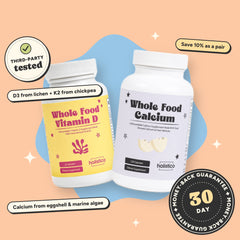
We built Holistico Whole Food Calcium from food sources so the calcium arrives the way it does on a plate, with company. Each two-capsule serving declares 500 mg of calcium, which is 38% of the Daily Value. It comes from three ingredients:
- ESC eggshell calcium, upcycled from eggshells.
- Aquamin F, a red marine algae harvested from the seabed off the west coast of Ireland and the northwest coast of Iceland. A 2024 paper in the journal Methods describes it as "rich in calcium (32%)" and says it carries "over 72 minerals, characteristic of their oceanic origin."
- 60 mg of horseradish tree (moringa) leaf.
The directions on the bottle are two capsules twice daily, with food. The capsule contains no dairy, and there is no magnesium stearate, silicon dioxide, titanium dioxide, gums or carrageenan. Each current lot passed independent heavy metal and microbe testing, and the full reports are on our lab results page.
The reason we start from food is laid out in a 2009 review in the American Journal of Clinical Nutrition: "Many examples are provided of superior effects of whole foods over their isolated constituents." For the longer argument, read whole food calcium vs synthetic calcium.
Does Calcium Work Alone?
No. Vitamin D is its closest partner. The same National Academies report calls the role of active vitamin D in calcium absorption "well-established." Vitamin D helps your body absorb the calcium on your plate.*
That is why we sell the two together. Holistico Whole Food Vitamin D pairs vitamin D3 from lichen with vitamin K2 as MK-7, fermented from chickpeas. We add beef liver, red algae for its minerals, and coconut oil because vitamin D is fat-soluble. The Whole Food Vitamin D and Calcium bundle puts both bottles in one order.
Questions People Ask About How Much Calcium You Need
How much calcium is in a glass of milk?
An 8 oz glass, which is one cup, holds 276 to 299 mg of calcium. Whole milk has 276 mg, or 21% of the Daily Value. Nonfat milk has 299 mg, or 23%. Those figures come from USDA FoodData Central, as listed by the NIH. For a woman of 19 to 50, one glass covers more than a quarter of her 1,000 mg RDA.
How much calcium is in whole milk?
One cup of whole milk (3.25% milk fat) has 276 mg of calcium, which is 21% of the 1,300 mg Daily Value. Nonfat milk has a little more per cup, at 299 mg. Both are among the richest everyday food sources on the NIH list.
How much calcium is in skim milk?
Skim milk, labeled nonfat, has 299 mg of calcium per cup. That is 23% of the Daily Value, and the same as a cup of calcium-fortified soymilk in the NIH table. Plain low-fat yogurt beats both at 415 mg for 8 oz. If you skip dairy, Holistico Whole Food Calcium contains no dairy and gives 500 mg per two-capsule serving.
How much calcium is in 8 oz of milk?
Eight ounces is one cup, so the cup figures apply: 276 mg for whole milk and 299 mg for nonfat. Three cups of nonfat milk would come to 897 mg. Our worked day above shows how milk, yogurt and cheese together can come close to a 1,200 mg RDA, and how fast the total drops on a day without them.
How much daily calcium do you need?
It depends on age and sex. The National Academies set 1,000 mg a day for most adults from 19 to 50. Women move to 1,200 mg at 51, and men at 71. Teens from 9 to 18 have the highest RDA, at 1,300 mg. The figure covers food and supplements together.
How much calcium and vitamin D do I need?
The National Academies RDA for calcium is 1,000 to 1,200 mg a day for adults, by age and sex. For vitamin D, the NIH lists one RDA for men and women, and it rises after 70. Our vitamin D page explains how we chose the amount in our capsule.
What is the most recommended calcium supplement?
Health agencies do not name brands. The NIH says most supplements use calcium carbonate or calcium citrate, and that the form and the amount taken at one time both shape absorption. We chose calcium from eggshell and red algae, with moringa leaf, so Holistico Whole Food Calcium starts from food and arrives with the trace minerals the algae carries.
Which foods have the most calcium besides milk?
From the NIH table: plain low-fat yogurt (415 mg per 8 oz), fortified orange juice (349 mg per cup), part-skim mozzarella (333 mg per 1.5 oz) and canned sardines with bones (325 mg per 3 oz). Firm tofu made with calcium sulfate gives 253 mg per half cup. Canned pink salmon with bones gives 181 mg per 3 oz.
How well does your body absorb calcium from food?
The NIH says absorption from dairy products and fortified foods "is about 30%." For supplements, it depends on the form and on how much elemental calcium you take at one time. Our label declares 500 mg per serving and directs two capsules twice daily with food, so the calcium arrives with a meal.
Important Safety Notes
- This article is general education. It is not medical advice, and it does not replace a conversation with your own practitioner.
- If you are pregnant, nursing or taking any medication, talk to your healthcare practitioner before you start a supplement.
- Holistico Whole Food Calcium is made from eggshell, so it is not for anyone with an egg allergy. It is for adult use only. Keep it out of reach of children.
- *These statements have not been evaluated by the Food and Drug Administration. This product is not intended to diagnose, treat, cure, or prevent any disease.
The Bottom Line
The National Academies set calcium at 1,000 mg a day for women from 19 to 50 and 1,200 mg from 51 on. Men stay at 1,000 mg until 70. A cup of milk gives 276 to 299 mg, and yogurt, cheese, sardines and tofu all add more. A test shows where you stand. If you want a capsule for the gap, Holistico Whole Food Calcium gives 500 mg per serving from eggshell and red algae, with moringa leaf, and contains no dairy.
Next, read calcium citrate vs calcium carbonate, or our post on calcium and digestion.
References
- Institute of Medicine (2011). Summary. In: Dietary Reference Intakes for Calcium and Vitamin D. Washington, DC: The National Academies Press. Table S-1.
- National Institutes of Health, Office of Dietary Supplements. Calcium: Fact Sheet for Health Professionals. Read November 19, 2026.
- National Institutes of Health, Office of Dietary Supplements. Vitamin D: Fact Sheet for Health Professionals. Read November 19, 2026.
- US Food and Drug Administration. Daily Value on the Nutrition and Supplement Facts Labels. Content current as of March 5, 2024.
- Institute of Medicine (2011). Overview of Vitamin D. In: Dietary Reference Intakes for Calcium and Vitamin D, chapter 3. Washington, DC: The National Academies Press.
- Dowley, A., Long-Smith, C. M., Demehin, O., Nolan, Y., O'Connell, S., & O'Gorman, D. M. (2024). The bioaccessibility and tolerability of marine-derived sources of magnesium and calcium. Methods, 226, 28-34.
- Jacobs, D. R., Gross, M. D., & Tapsell, L. C. (2009). Food synergy: an operational concept for understanding nutrition. American Journal of Clinical Nutrition, 89(5), 1543S-1548S.