Does a Calcium Supplement Cause Constipation? What to Look For in the Bottle

Yes, a calcium supplement can cause constipation in some people. The National Institutes of Health names gas, bloating and constipation as the gut complaints linked to calcium, and says smaller amounts and taking it with meals both help. We built Holistico Whole Food Calcium around those two things, starting from eggshell and red algae.
Does a Calcium Supplement Cause Constipation?
It can. Gas, bloating and constipation are the three calcium supplement side effects the NIH lists, and its wording is that some people who take calcium run into them. So it is common enough to make the official list and a long way from universal.
The same fact sheet names three things that ease the problem. Take smaller amounts more often. Take calcium with meals. Switch to a different form. Hold on to those three, because they are how we designed our own calcium.
Calcium Carbonate vs Calcium Citrate: Does the Form Matter?
Most bottles on the shelf are a calcium carbonate supplement or a calcium citrate supplement. Each is a single mineral salt, and the carbonate in a conventional tablet is typically ground from limestone. Here is how they sit next to a whole food calcium.
| Calcium carbonate | Calcium citrate | Eggshell and red algae (ours) | |
|---|---|---|---|
| What it is | A single mineral salt, usually from limestone | A single mineral salt made with citric acid | Calcium as it occurs in eggshell and in a red algae skeleton |
| Calcium content | 40% by weight | 21% by weight | 500 mg in a two-capsule serving |
| Food | Absorbs best with a meal | With or without food | We suggest every serving with a meal |
| What the source carries | Calcium only | Calcium only | Magnesium and more than 70 trace minerals from the algae, with moringa leaf added |
The NIH says calcium carbonate appears to cause more gas, bloating and constipation than calcium citrate, especially in older adults with less stomach acid.
Now the part most labels skip. By chemistry, eggshell and algae calcium are carbonate too, and we say so in our post on eggshell calcium. The difference is in everything around the calcium: where it grew, what it grew with, and how the serving is set up. That is where the other two NIH fixes come in.
How Can You Avoid Constipation From Calcium Supplements?
Begin with the NIH's own list: smaller amounts more often, with meals, and a change of form if you need one. Its guidance on eating for constipation adds two more. Drink plenty of liquids, and aim for 22 to 34 grams of fiber a day, depending on your age and sex.
Then look at how your calcium is built. This is where we put our effort with Holistico Whole Food Calcium.
- Smaller amounts. Each two-capsule serving gives 500 mg of calcium. The NIH says absorption from supplements is highest at 500 mg or less, so we suggest two capsules twice a day and never one big hit.
- With meals. We suggest taking every serving with food.
- A different source. The calcium comes from eggshell and red algae in place of limestone, and the algae brings its magnesium and trace minerals along.
Food comes first, always. A capsule fills the gap your plate leaves, and the more it looks like food, the better we like it.
Is Whole Food Calcium Easier on the Stomach?
I am a Registered Holistic Nutritionist, and I can tell you what I have seen. In my own practice, hundreds of clients have had far less stomach upset, or none at all, on whole food supplements, and calcium is where I notice it most. That is my experience with my own clients. It is not a clinical study, and your body may respond in its own way.
Two facts are worth setting beside it.
The first is about food. A review in the American Journal of Clinical Nutrition notes that food provides a buffer during absorption, and that nutrients delivered in their natural setting may act differently from processed ones. That idea is the reason we make whole food supplements at all.
The second is about the algae. Aquamin F, the red algae in our capsule, went through a 12-week placebo-controlled study in a small group of healthy older adults. The company that harvests it ran the study and gave it together with a seawater magnesium. The supplement was well tolerated, with no significant adverse events reported.
What Is in Holistico Whole Food Calcium?
Two foods and a leaf. The calcium comes from upcycled eggshells and from Aquamin F, a red algae from the North Atlantic that draws minerals out of seawater and builds them into its own skeleton. The paper behind that 12-week study describes it as rich in calcium, with more than 72 minerals from the sea. We add 60 mg of horseradish tree (moringa) leaf for its trace minerals.
A two-capsule serving gives 500 mg of calcium, which is 38% of the Daily Value. The only other ingredients are rice flour, bamboo extract and the vegetable capsule shell. There is no magnesium stearate, silicon dioxide, titanium dioxide, gums or carrageenan, and no dairy. Every batch is tested for potency and identity, then third-party tested for heavy metals and microbial safety. Because it is made from eggshell, it is not for anyone with an egg allergy.
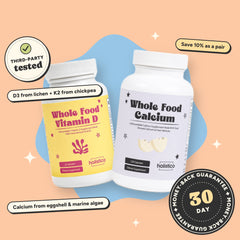
Calcium has partners of its own. Your body needs vitamin D to absorb calcium, and vitamin K2 switches on the bone protein that holds on to it. So we sell the two bottles together as the Whole Food Vitamin D and Calcium bundle.
Questions People Ask About Calcium and Constipation
What is the most common side effect of calcium supplementation?
Gut complaints. The NIH Office of Dietary Supplements names gas, bloating and constipation. It also names what eases them: smaller amounts more often, taking calcium with meals, or a different form. Holistico Whole Food Calcium is set up for the first two, with 500 mg per serving and every serving taken with food.
Which calcium supplement does not cause constipation?
Look for one built on what the NIH says eases it: 500 mg or less at a time, taken with meals. Then look at the source. Holistico Whole Food Calcium gives 500 mg per serving, with food, from eggshell and red algae with its trace minerals. In my own practice, hundreds of clients have had far less stomach upset on whole food supplements. That is my experience and not a clinical study.
What is the best form of calcium to take?
The one you can take in small amounts with meals, from a source you can name. Calcium carbonate is 40% calcium by weight and absorbs best with food. Calcium citrate is 21% and can be taken without food. We chose calcium from eggshell and red algae because it arrives with the minerals those foods carry, and we set each serving at 500 mg.
Does calcium cause constipation or diarrhea?
Constipation is the one on the NIH's list for calcium, along with gas and bloating. Diarrhea belongs to another mineral: the NIH magnesium fact sheet says high amounts of magnesium from supplements often cause it. In food the two minerals turn up together, as they do in the red algae we use.
Can vitamin D and calcium cause constipation?
Of the two, calcium is the one the NIH links with constipation. Vitamin D's part is to help your body absorb calcium. If a combined tablet bothers you, the NIH's fixes still apply: smaller amounts, with meals. Our bundle keeps calcium and vitamin D in separate bottles, so the calcium can go in 500 mg at a time with food.
What vitamin should not be taken together with calcium?
Minerals are the bigger question. A National Academies report says calcium can compete with iron, zinc and magnesium for absorption. It is one reason we make single-nutrient capsules and not a multivitamin with everything packed into one tablet. If you take any medication, ask your pharmacist how to time it around calcium.
Is algae calcium better than regular calcium?
It is a different thing. Regular calcium is one mineral salt on its own. Red algae builds calcium into its skeleton from seawater, along with magnesium and more than 70 trace minerals. In a 12-week study of healthy older adults, a supplement containing it was well tolerated. We use it with eggshell in Holistico Whole Food Calcium.
Is there a calcium supplement without dairy?
Yes. Holistico Whole Food Calcium contains no dairy. Its calcium comes from eggshell and North Atlantic red algae, with horseradish tree leaf. Because it is made from eggshell, it suits most vegetarians and does not suit vegans or anyone with an egg allergy.
Should you take calcium with food?
Yes. Taking calcium with meals is one of the three things the NIH names for easing gut complaints, and carbonate forms absorb best with food. We suggest two capsules of Whole Food Calcium twice a day, each time with a meal. Breakfast and dinner make an easy routine.
What is the healthiest calcium supplement to take?
We think it is the one that looks most like food. That means calcium from a food source, the minerals that source carries, an amount your body can absorb at one sitting, a short "other ingredients" line, and test results you can ask for. Holistico Whole Food Calcium was made to that list.
Important Safety Notes
- This article is general education. It is not medical advice, and it does not replace a conversation with your own practitioner.
- If you are pregnant, nursing or taking any medication, talk to your healthcare practitioner before you start.
- Constipation that does not ease, or that worries you, is a reason to talk to your doctor.
- Holistico Whole Food Calcium is made from eggshell.
- These statements have not been evaluated by the Food and Drug Administration. This product is not intended to diagnose, treat, cure, or prevent any disease.
The Bottom Line
A calcium supplement can cause constipation in some people, and the NIH names three things that ease it: smaller amounts, meals and a change of form. Water and fiber help too. Holistico Whole Food Calcium is built on that advice, with 500 mg per serving, taken with food, from eggshell and red algae with the minerals they carry. Start with food, test your levels, and fill the gap with a capsule that looks like food.
Next, read how whole food calcium differs from synthetic calcium, or why vitamin D3 and K2 belong in one capsule.
References
- National Institutes of Health, Office of Dietary Supplements. Calcium: Fact Sheet for Health Professionals. Updated June 22, 2026.
- National Institutes of Health, NIDDK. Eating, Diet, and Nutrition for Constipation. Last reviewed May 2018.
- Jacobs, D. R., Gross, M. D., & Tapsell, L. C. (2009). Food synergy: an operational concept for understanding nutrition. American Journal of Clinical Nutrition, 89(5), 1543S-1548S.
- Dowley, A., Long-Smith, C. M., Demehin, O., Nolan, Y., O'Connell, S., & O'Gorman, D. M. (2024). The bioaccessibility and tolerability of marine-derived sources of magnesium and calcium. Methods, 226, 28-34.
- Institute of Medicine (2011). Overview of Vitamin D. In: Dietary Reference Intakes for Calcium and Vitamin D, chapter 3. Washington, DC: The National Academies Press.
- Institute of Medicine (2011). Overview of Calcium. In: Dietary Reference Intakes for Calcium and Vitamin D, chapter 2. Washington, DC: The National Academies Press.
- National Institutes of Health, Office of Dietary Supplements. Magnesium: Fact Sheet for Health Professionals. Updated January 6, 2026.