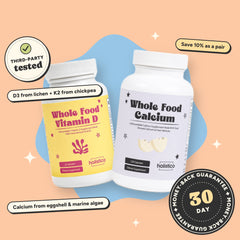
Coconut flesh oil: the fat in our vitamin D
Why 69.5 mg of powdered coconut oil shares a capsule with vitamin D3 and K2.
Each capsule of Whole Food Vitamin D3 + K2 contains 69.5 mg of powdered coconut flesh oil. Vitamin D3 and vitamin K2 are both fat-soluble, and the coconut adds a food-based fat for absorption.
Our coconut oil at a glance
| Label name | Coconut Flesh Oil, Powdered |
|---|---|
| What it is | Oil from the white flesh of the coconut, dried to a powder so it can be measured into a capsule |
| Amount | 69.5 mg per capsule |
| Found in | Whole Food Vitamin D3 + K2, beside 5,000 IU (125 mcg) of vitamin D3 from lichen and 50 mcg of K2 |
| Allergen | Contains tree nuts (coconut) |
| Not in | Whole Food Calcium, which declares no coconut |
| Tested | Each current lot passed independent heavy metal and microbe testing (lab results) |
Why a vitamin D capsule carries fat
The NIH Office of Dietary Supplements describes vitamin D as "a fat-soluble vitamin that is naturally present in a few foods". It also notes that "the concurrent presence of fat in the gut enhances vitamin D absorption, but some vitamin D is absorbed even without dietary fat" (NIH ODS, Vitamin D).
In food, vitamin D usually arrives inside fat: oily fish, egg yolk, liver. Katie wanted the capsule to follow that pattern, so the D3 from lichen and the K2 fermented from chickpeas share the capsule with coconut flesh oil, the way they would share a plate with fat at a meal.
Why we still say take it with food
69.5 mg is a small amount of fat, a partner inside the capsule rather than a meal. Our label directs one capsule daily with food, and Katie takes hers every morning at breakfast, so the capsule meets the fat in your meal too. Our post on the best time to take vitamin D3 and K2 covers timing in more detail.
Why coconut
Coconut flesh oil is a whole food fat that dries well into a stable powder, which makes it practical in a capsule. Rosemary leaf extract sits in the same formula as a natural antioxidant that protects the oils and keeps the formula fresh.
Why is coconut oil in a vitamin D supplement?
Vitamin D3 and K2 are fat-soluble, and in food they usually arrive inside fat. Each capsule of Whole Food Vitamin D3 + K2 holds 69.5 mg of powdered coconut flesh oil, a food-based fat for absorption, alongside the vitamins.
Is vitamin D fat-soluble?
Yes. The NIH Office of Dietary Supplements calls vitamin D "a fat-soluble vitamin that is naturally present in a few foods". Vitamin K, including K2, is fat-soluble too.
Should I take vitamin D with fat?
The NIH notes that "the concurrent presence of fat in the gut enhances vitamin D absorption, but some vitamin D is absorbed even without dietary fat." Our label directs one capsule daily with food, and Katie takes hers at breakfast.
How much coconut oil is in each capsule?
69.5 mg, printed on the Supplement Facts panel as "Coconut Flesh Oil, Powdered". It is a small amount: a partner inside the capsule, not a replacement for the fat in your meal.
Is coconut a tree nut allergen?
Our product lists it as containing tree nuts (coconut). If you avoid coconut, Whole Food Vitamin D3 + K2 is not for you. Whole Food Calcium declares no coconut.
Is calcium fat-soluble?
No. Calcium is a mineral, while the fat-soluble vitamins are A, D, E and K. That is why coconut oil is in our vitamin D capsule and not in Whole Food Calcium. The calcium label still directs two capsules twice daily with food.
Why powdered coconut oil instead of liquid oil?
A powder can be measured evenly into a dry capsule, while a liquid oil would need a softgel. Powdering lets the coconut sit in the same veggie capsule as the lichen D3, K2 and the other whole food powders. Rosemary leaf extract in the formula is a natural antioxidant that protects the oils and keeps the formula fresh.
Can I take it if I am pregnant or on medication?
If you are pregnant, nursing or taking any medications, talk to your healthcare practitioner before use, as our label says. That caution covers the whole formula.
*These statements have not been evaluated by the Food and Drug Administration. This product is not intended to diagnose, treat, cure, or prevent any disease.