When Is the Best Time to Take Vitamin D3 and K2?

The best time to take vitamin D3 and K2 is with a meal that has some fat in it, at the same time each day. Morning or night, either works. Both vitamins are fat-soluble, so food carries them in. That is why we suggest taking Holistico Whole Food Vitamin D with food, once a day. We also built coconut oil right into the capsule as a healthy fat source to support absorption.
When Is the Best Time to Take Vitamin D3 and K2?
With your meal. The timing matters less.
Vitamin D and vitamin K both dissolve in fat, not water. The NIH Office of Dietary Supplements says fat in the gut enhances vitamin D absorption, though some is absorbed even without it. The National Academies report on vitamin D puts it more plainly: vitamin D is most efficiently absorbed when eaten with foods that contain fat.
In a one-day study of 50 healthy older adults, people took a single large dose of D3 with breakfast, and the dose reached a peak in the blood 32% higher when that breakfast had fat in it than when it was fat-free. The type of fat made no difference. Olive oil, butter or eggs all count.
So when to take vitamin D3 and K2 comes down to two things you control. Pick a meal with some fat. Pick one you eat every day.
Is Morning or Night Better for Vitamin D3 and K2?
Neither one wins on absorption. The meal does. If your breakfast is coffee on the run and your dinner is salmon and vegetables, dinner is your slot. If you eat eggs every morning and dinner moves around, take it at breakfast.
The K2 side of the capsule makes this easier. The K2 we use is menaquinone-7, usually written MK-7. In a study in healthy volunteers, MK-7 peaked in the blood about four hours after a dose, and because it leaves the body slowly, daily use built it up to a level 7 to 8 times higher and kept it steady. A long-lasting vitamin rewards the same capsule at the same meal, day after day, far more than it rewards a perfect hour.
Many people like the morning because the bottle sits next to the coffee and the habit sticks. That is a good reason. A habit you keep beats a schedule you forget by Thursday.
That is what Katie, our founder and Holistic Nutrition Consultant, does: "I take 1 capsule every morning at breakfast."
Why Does Fat Help D3 and K2 Get Absorbed?
Your gut handles fat-soluble vitamins the way it handles fat. Bile and enzymes from the pancreas wrap them into tiny droplets, the gut wall takes them up, and they travel out in the same packages that carry dietary fat. The NIH fact sheet on vitamin K describes this same route for vitamin K. No fat in the meal means less of that machinery is running.
Food already knows this. The natural sources of vitamin D are fatty fish, fish liver oil and egg yolk, and every one of them brings its own fat. In nature, nutrients never arrive alone. They come packaged with fats, minerals and partner vitamins, a mix often called the food matrix.
That idea is the whole reason Holistico exists. Most D3 and K2 supplements are two isolated compounds in a capsule of filler. We start with one nutrient from a whole food and add the foods that carry its partners, so the capsule looks more like a meal than a lab sample.
What Goes Into the Capsule You Take With Your Meal?
Here is what is inside each Holistico Whole Food Vitamin D capsule, and why we chose each food:
- 125 mcg (5,000 IU) of vitamin D3 from wild-harvested lichen. We chose lichen because it makes D3 from sunlight the same way your skin does.
- 50 mcg of vitamin K2 as MK-7, fermented from non-GMO chickpeas. I call K2 the traffic controller for D3: D3 brings calcium in, and K2 switches on the bone protein that holds on to it.
- 150 mg of beef liver powder, a food that naturally contains retinol, the form of vitamin A found in animal foods.
- 50 mg of red marine algae, which naturally holds magnesium and more than 70 trace minerals. Your body converts vitamin D before it can use it, and a 2018 review reported that every enzyme doing that work appears to need magnesium.
- 69.5 mg of coconut oil powder, a food source of fat, so the capsule carries a little fat of its own for absorption.
What we left out matters too. You will find no magnesium stearate, silicon dioxide, titanium dioxide, gums or carrageenan on the label. Every batch is tested for potency and identity, then third-party tested for heavy metals and microbial safety, and it is made in an FDA-registered, cGMP-certified facility. See the full label and the test results on the product page.
How Do You Fit Vitamin D3 and K2 Into Your Day?
Tie it to something you already do. Here is how that can look:
- Breakfast eaters: one capsule with eggs, yogurt or avocado toast.
- If you skip breakfast or fast in the mornings: one capsule with your first real meal, whenever that lands.
- Busy mornings: one capsule with dinner, where the fat is usually easier to find.
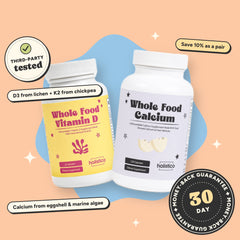
If you also take calcium, the two fit together well. We suggest two capsules of Whole Food Calcium twice a day with food, so your vitamin D capsule can ride along with one of those meals. Calcium, D3 and K2 are a team, and the Whole Food Vitamin D and Calcium bundle puts both bottles in one order.
And before you start, find out where your levels stand. Vitamin D is one of the easiest nutrients to track on a blood test, and our rule is test, don't guess. The nutrient test we offer looks at 55 markers inside your white blood cells, with vitamin D, K2 and magnesium among them.
Questions People Ask About the Best Time to Take Vitamin D3 and K2
Is it better to take D3 and K2 at night or morning?
Either works, as long as you take it with a meal that has some fat. Fat helps your gut absorb both vitamins, so the plate matters more than the clock. Choose the meal you never skip. For many people that is breakfast. We suggest one capsule of Holistico Whole Food Vitamin D a day with food.
Should I take D3 and K2 at the same time?
Yes. They work on the same mineral, they are both fat-soluble, and one meal carries both. That is why we put them in a single capsule: Holistico Whole Food Vitamin D has 125 mcg of D3 from lichen and 50 mcg of K2 from fermented chickpeas together, with the food partners alongside. One capsule, one meal, nothing to time apart.
What time of day should you take D3, K2, and magnesium?
With a meal, at whatever time you eat reliably. Magnesium is a partner for vitamin D, since the enzymes that convert vitamin D appear to need it. Our vitamin D capsule includes red marine algae, which naturally contains magnesium and more than 70 trace minerals, so that partner comes in the same capsule at the same meal.
Can I take vitamin D3 and K2 with calcium?
Yes, and they belong together. Vitamin D helps your gut absorb calcium, and K2 switches on the protein that keeps it in bone. We suggest Holistico Whole Food Calcium as two capsules twice a day with food, so your vitamin D capsule can go with one of those meals. Our calcium comes from upcycled eggshell and red marine algae.
Do I need to take vitamin D3 and K2 with food?
Food helps. In one study of healthy older adults, a dose of D3 taken with a breakfast containing fat reached a 32% higher peak in the blood than the same dose with a fat-free breakfast. Both vitamins travel with fat through the gut. A normal meal with eggs, fish, avocado, olive oil or butter is enough.
Can I take D3 and K2 on an empty stomach?
You will absorb some, but you get more from it with food. The NIH says fat in the gut enhances vitamin D absorption. If you fast in the mornings, take your capsule with your first meal of the day instead. Holistico Whole Food Vitamin D carries a little coconut oil to help, and a meal does the rest.
What if I forget a dose of D3 and K2?
Take it with your next meal and carry on the next day as usual. Both vitamins stay in the body for a long time. K2 as MK-7 leaves slowly and holds a steady level with daily use. A single missed day barely moves that. What counts is the habit over weeks, which is why tying the capsule to a meal you always eat works so well.
What to avoid when taking vitamin D3 and K2?
Skip the empty stomach and the fat-free meal. Add up every label you take, because vitamin D also shows up in many multivitamins. If you take any medication, ask your prescriber first, since vitamin K is involved in normal blood clotting. For what changes over weeks of daily use, read what happens if you take vitamin D3 and K2 every day.
Important Safety Notes
- This article is general education. It is not medical advice, and it does not replace a conversation with your own practitioner.
- If you are pregnant, nursing or taking any medication, talk to your healthcare practitioner before you start.
- Vitamin K is involved in normal blood clotting. Anyone on a blood-thinning medicine needs their prescriber's go-ahead before adding it.
- Holistico Whole Food Vitamin D contains beef liver powder and coconut (a tree nut allergen), so it is not vegetarian.
- These statements have not been evaluated by the Food and Drug Administration. This product is not intended to diagnose, treat, cure, or prevent any disease.
The Bottom Line
The best time to take vitamin D3 and K2 is with a meal that contains some fat, at the same time every day. Fat helps your gut absorb both vitamins, and K2 as MK-7 builds a steady level with daily use, so a consistent habit beats a perfect hour. Morning works if breakfast is your steady meal; dinner works if it is not. Holistico Whole Food Vitamin D is a vitamin D3 and K2 supplement that puts D3 from lichen and K2 from chickpeas in one capsule with beef liver, red algae and coconut oil, and we suggest one a day with food.
References
- National Institutes of Health, Office of Dietary Supplements (updated June 27, 2025). Vitamin D: Fact Sheet for Health Professionals.
- National Institutes of Health, Office of Dietary Supplements. Vitamin K: Fact Sheet for Health Professionals.
- Institute of Medicine (2011). Overview of Vitamin D. In: Dietary Reference Intakes for Calcium and Vitamin D, chapter 3. Washington, DC: The National Academies Press.
- Dawson-Hughes, B., Harris, S. S., Lichtenstein, A. H., Dolnikowski, G., Palermo, N. J., & Rasmussen, H. (2015). Dietary fat increases vitamin D-3 absorption. Journal of the Academy of Nutrition and Dietetics, 115(2), 225-230.
- Schurgers, L. J., Teunissen, K. J., Hamulyák, K., Knapen, M. H., Vik, H., & Vermeer, C. (2007). Vitamin K-containing dietary supplements: comparison of synthetic vitamin K1 and natto-derived menaquinone-7. Blood, 109(8), 3279-3283.
- Uwitonze, A. M., & Razzaque, M. S. (2018). Role of magnesium in vitamin D activation and function. Journal of the American Osteopathic Association, 118(3), 181-189.