Algae Calcium vs Eggshell Calcium: What Is the Difference?

Algae calcium comes from a red seaweed, and the algae naturally carries magnesium and 70+ trace minerals alongside its calcium. Eggshell calcium is dense calcium carbonate, built by a hen. One brings range, the other brings concentration. Holistico Whole Food Calcium uses both, so every serving is calcium from whole food with the minerals it grew with.
What Is the Difference Between Algae Calcium and Eggshell Calcium?
The source, and what travels with the calcium. Both are whole food calcium, made by living things.
Eggshell is mostly calcium carbonate. A mineral analysis of chicken eggshell powder found "a beneficial composition with about 39% of elemental Ca". That makes eggshell one of the more concentrated calcium sources in food.
Algae calcium is broader. Aquamin F, the red algae in Holistico Whole Food Calcium, is described in a 2024 paper in the journal Methods as a seaweed mineral "rich in calcium (32%)" that also carries more than 72 minerals from the ocean. Magnesium is one of them.
| Eggshell calcium | Red algae calcium (Aquamin F) | |
|---|---|---|
| Where it comes from | Upcycled chicken eggshell | Lithothamnion red algae from the seabed off Ireland and Iceland |
| Calcium by weight | About 39% | About 32% |
| What comes with it | Small amounts of other minerals | Magnesium and more than 70 trace minerals |
| What it adds to our formula | Concentrated calcium from food | The ocean's spread of minerals around the calcium |
What Is Eggshell Calcium?
It is the shell of a chicken egg, cleaned and milled into a fine powder. The hen lays the shell down as calcium carbonate around a protein frame, using minerals from her own diet.
The eggshell in our capsule is ESC eggshell calcium, a trademarked ingredient made from upcycled shells. Upcycled means the shells are put to use and not thrown away.
Because eggshell is carbonate, it follows the carbonate rule. The NIH Office of Dietary Supplements says "Calcium carbonate is absorbed best when taken with food." That is why we suggest every serving with a meal. We cover the eggshell side in more depth in eggshell calcium vs calcium carbonate.
What Is Algae Calcium?
Algae calcium is calcium from a red seaweed whose body is rich in minerals. Ours is Aquamin F, made from Lithothamnion red algae harvested from the seabed off the west coast of Ireland and the northwest coast of Iceland, in clear, mineral rich Atlantic waters.
The algae gathers minerals from seawater as it grows. That is why the algae naturally carries magnesium and 70+ trace minerals alongside its calcium.
Why Does Holistico Use Both?
Because each one does a job the other cannot do alone. Eggshell brings concentrated calcium from food. Algae brings the minerals that calcium meets in nature.
Calcium works with partners, and in food it arrives with them. A review in the American Journal of Clinical Nutrition puts it simply: "In food, however, the biological constituents are coordinated." Magnesium is one of calcium's closest partners. The NIH magnesium fact sheet says magnesium contributes to the structural development of bone, and that 50% to 60% of the body's magnesium sits in the bones.
So we built Holistico Whole Food Calcium on the two together. Eggshell brings dense calcium. The algae naturally carries magnesium and 70+ trace minerals alongside its calcium. We add 60 mg of horseradish tree (moringa) leaf for its own trace minerals.
Three foods, one capsule.
How Is the Serving Built?
Each two-capsule serving gives 500 mg of calcium, 38% of the Daily Value. The NIH says calcium is absorbed best at 500 mg or less at one time, so we suggest two capsules twice daily, each time with food, and never one large hit.
The other ingredients are rice flour, bamboo extract and the vegetable capsule. There is no magnesium stearate, silicon dioxide, titanium dioxide, gums or carrageenan, and it contains no dairy. Each current lot passed independent heavy metal and microbe testing, and the full reports are on our lab results page.
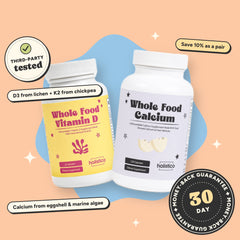
Calcium has one more partner. The NIH calcium fact sheet says vitamin D is required for calcium to be absorbed in the gut by active transport. We sell the two side by side as the Whole Food Vitamin D and Calcium bundle, and you can test your levels before you choose. For the mineral pairing, read calcium and magnesium together.
Questions People Ask About Algae Calcium and Eggshell Calcium
What is Aquamin?
Aquamin is a trademarked mineral ingredient from Marigot Ltd of Cork, Ireland. Aquamin F is made from Lithothamnion red algae, and a 2024 paper describes it as about 32% calcium with more than 72 minerals from the ocean. It is the algae half of Holistico Whole Food Calcium, next to eggshell.
What is Aquamin F?
Aquamin F is the calcium-rich form of Aquamin, made from Lithothamnion red algae harvested from the seabed off the west coast of Ireland and the northwest coast of Iceland. The algae naturally carries magnesium and 70+ trace minerals alongside its calcium. In Holistico Whole Food Calcium it sits beside upcycled eggshell and moringa leaf.
Is algae calcium better?
It is different. Eggshell gives more calcium per gram, about 39% against about 32% for the algae. The algae gives a wider spread of minerals, including magnesium and more than 70 trace minerals. We chose not to pick one. Holistico Whole Food Calcium puts both in the same capsule so you get the strength of each.
Are eggshells a good source of calcium?
Yes. A mineral analysis of chicken eggshell powder found about 39% calcium by weight, close to any calcium carbonate. The authors wrote that eggshell powder "may be used as a Ca source in human nutrition." We use upcycled eggshell as the base of our calcium for that reason.
Is eggshell calcium good for you?
Eggshell is calcium carbonate made by a living animal, and it is one of the more concentrated food sources of calcium. The Institute of Medicine says over 99 percent of the calcium in your body is in bones and teeth. We pair eggshell with red algae, which naturally carries magnesium and 70+ trace minerals alongside its calcium, and we suggest every serving with food.
Is Aquamin the same as carrageenan?
No. Carrageenan is a refined extract from other families of red seaweed, used as a food additive. US rules define it that way. Aquamin F is a seaweed mineral from Lithothamnion red algae, The algae naturally carries magnesium and 70+ trace minerals alongside its calcium. Holistico Whole Food Calcium contains no carrageenan and no gums.
What is red algae calcium?
Red algae calcium is calcium from the mineral-rich body of a red seaweed. Ours is Lithothamnion, harvested from the seabed off the west coast of Ireland and the northwest coast of Iceland. The algae naturally carries magnesium and 70+ trace minerals alongside its calcium, which is why we use it alongside eggshell.
Where can I buy Aquamin?
Aquamin is an ingredient, so you buy it inside a finished supplement. Holistico Whole Food Calcium uses Aquamin F red algae with ESC eggshell calcium and moringa leaf, at 500 mg of calcium per two-capsule serving. It ships across the US, and the lab reports for the current lot are on our website.
Important Safety Notes
- This article is general education. It is not medical advice and does not replace a conversation with your own practitioner.
- If you are pregnant, nursing or taking any medication, talk to your healthcare practitioner before you start a supplement.
- Calcium can affect how some medications are absorbed. Ask your pharmacist how to time them.
- Holistico Whole Food Calcium is made from eggshell, so it is not for anyone with an egg allergy. It is not vegan.
- These statements have not been evaluated by the Food and Drug Administration. This product is not intended to diagnose, treat, cure, or prevent any disease.
The Bottom Line
Eggshell calcium is concentrated calcium carbonate from food, about 39% calcium by weight. Algae calcium from Aquamin F red algae is about 32% calcium, and the algae naturally carries magnesium and 70+ trace minerals alongside its calcium. Each is a whole food source with its own strength. Holistico Whole Food Calcium combines them, with moringa leaf, at 500 mg per two-capsule serving taken with food, so your calcium arrives with the minerals it grew with.
Next, read calcium citrate vs calcium carbonate or why the source of calcium matters.
References
- Schaafsma, A., Pakan, I., Hofstede, G. J., Muskiet, F. A., Van Der Veer, E., & De Vries, P. J. (2000). Mineral, amino acid, and hormonal composition of chicken eggshell powder and the evaluation of its use in human nutrition. Poultry Science, 79(12), 1833-1838.
- Dowley, A., Long-Smith, C. M., Demehin, O., Nolan, Y., O'Connell, S., & O'Gorman, D. M. (2024). The bioaccessibility and tolerability of marine-derived sources of magnesium and calcium. Methods, 226, 28-34.
- National Institutes of Health, Office of Dietary Supplements. Calcium: Fact Sheet for Consumers. Updated September 14, 2023.
- Jacobs, D. R., Gross, M. D., & Tapsell, L. C. (2009). Food synergy: an operational concept for understanding nutrition. American Journal of Clinical Nutrition, 89(5), 1543S-1548S.
- National Institutes of Health, Office of Dietary Supplements. Magnesium: Fact Sheet for Health Professionals. Updated January 6, 2026.
- National Institutes of Health, Office of Dietary Supplements. Calcium: Fact Sheet for Health Professionals. Updated June 22, 2026.
- Institute of Medicine (2011). Overview of Calcium. In: Dietary Reference Intakes for Calcium and Vitamin D, chapter 2. Washington, DC: The National Academies Press.
- US Food and Drug Administration. 21 CFR 172.620, Carrageenan. Electronic Code of Federal Regulations.